Environment art is the art of Arborwake's places: the permanent maps, the Threadway, the run rooms and the interiors. It follows the Art direction, with Threadway B08 as the style anchor.
Pipeline#
The current pipeline has four steps:
- Concept. The user supplies concept studies, often made in ChatGPT, or the session makes a Meshy image-to-image redraw with plenty of plants. These are concepts only.
- Model. Meshy turns a concept into a 3D model (geometry only), or the scene is built from simple primitives. The user confirms every paid Meshy call first.
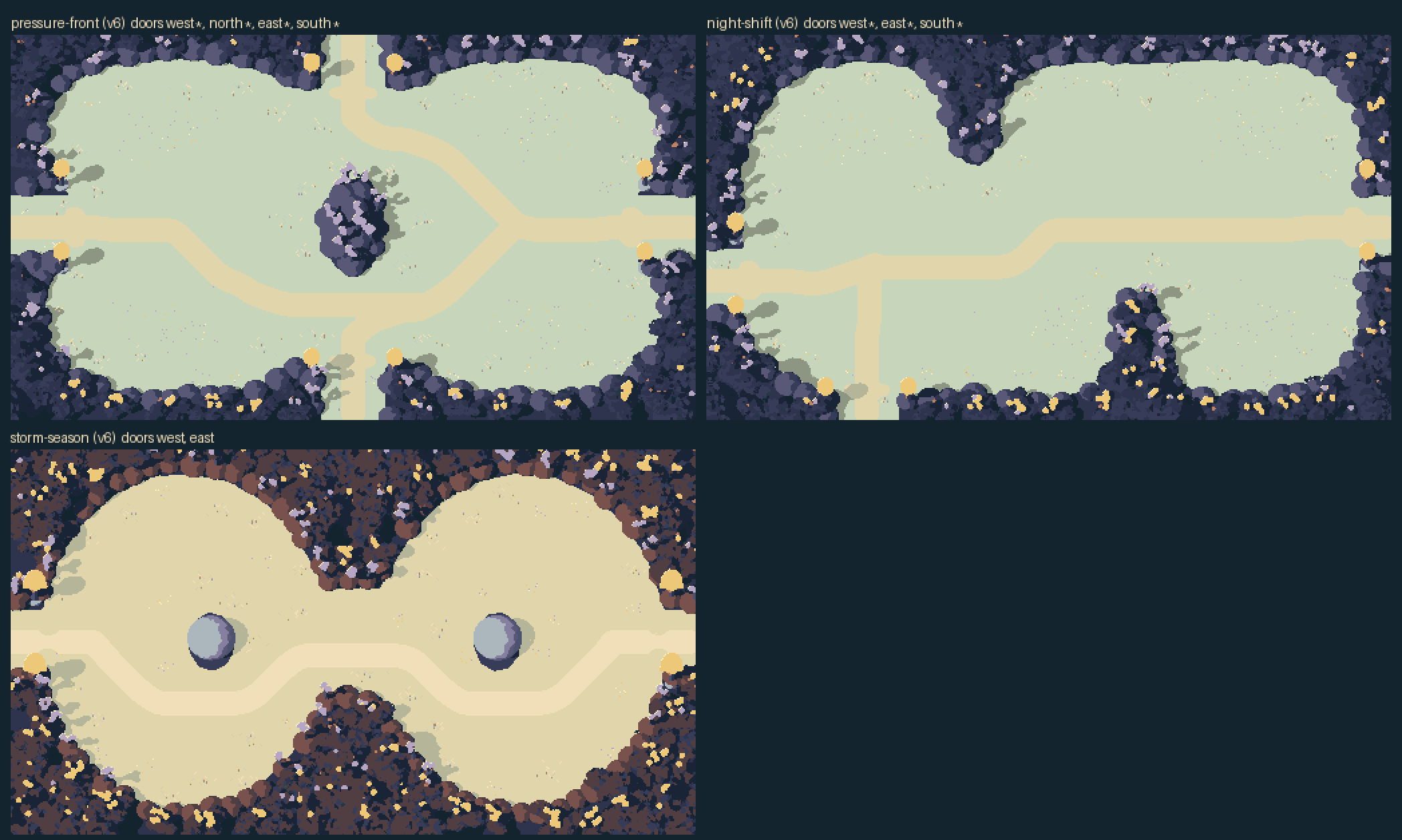
- Render. Blender renders the scene with an orthographic or tilted game camera and flat toon materials. Each place keeps its own camera, so later pieces (such as ground damage) are modelled in that same camera and light.
- Pixel pass. A finish script and hand work in Aseprite produce the layered pixel art. Characters are never baked in; cells stand at runtime on map anchors.
Two lessons shaped this pipeline. Rendering Meshy's painted textures gave "speckled painterly mush", so Meshy is used for shape, not texture. On 29 October the user also rejected a street of BlenderKit stock buildings because "things are clipping left right and center". Since then any layout that places models must check for overlaps.
Rejected first packages#
| Package | Result |
|---|---|
| r01–r03, scripted pixel art (27 October) | Retired The user rejected all three for artistic quality |
| Composition redesign and solarpunk studies | Retired Unapproved; below the requested finish |
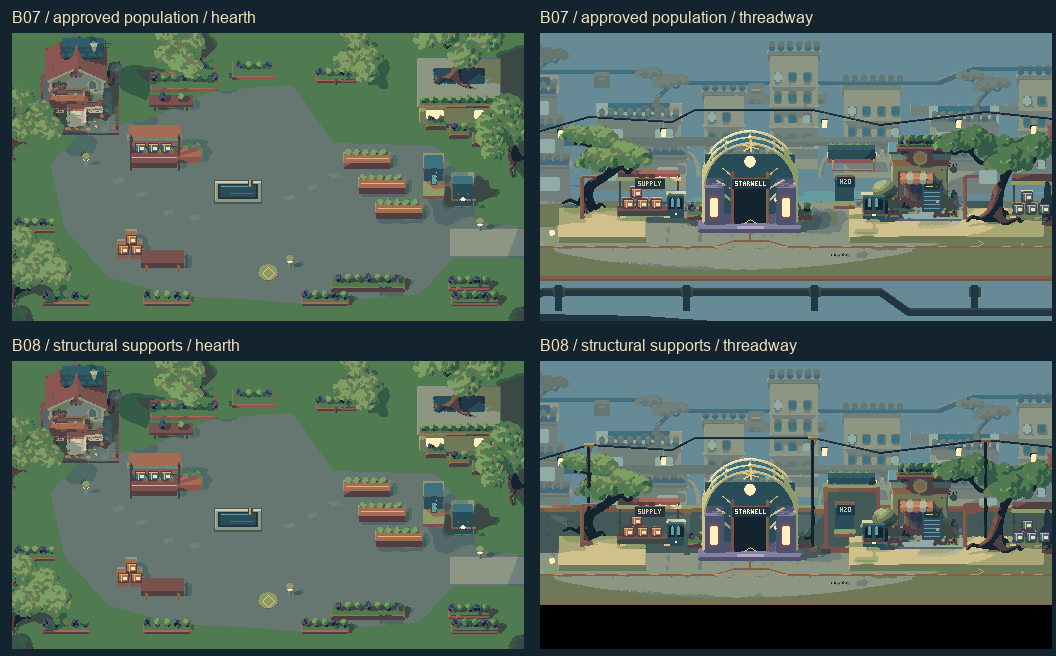
| Blender study B01–B07 | Superseded by B08 |
| Blender study B08 (29 October) | Approved The style anchor |
District palettes and function#
Each district has a palette distinct from its neighbours while it shares the B08 palette and finish. When Starwell first read as a housing estate, the user asked whether a wilderness gate in a housing area is even logical. Its rows of flats were replaced by staging, a depot and a control tower, and its palette moved to violet dusk and lilac stone. See Palettes.
Approved places#
- Hearth H14 (30 October), then H15 with home layout A and the neurons' yards (31 October). See Home art.
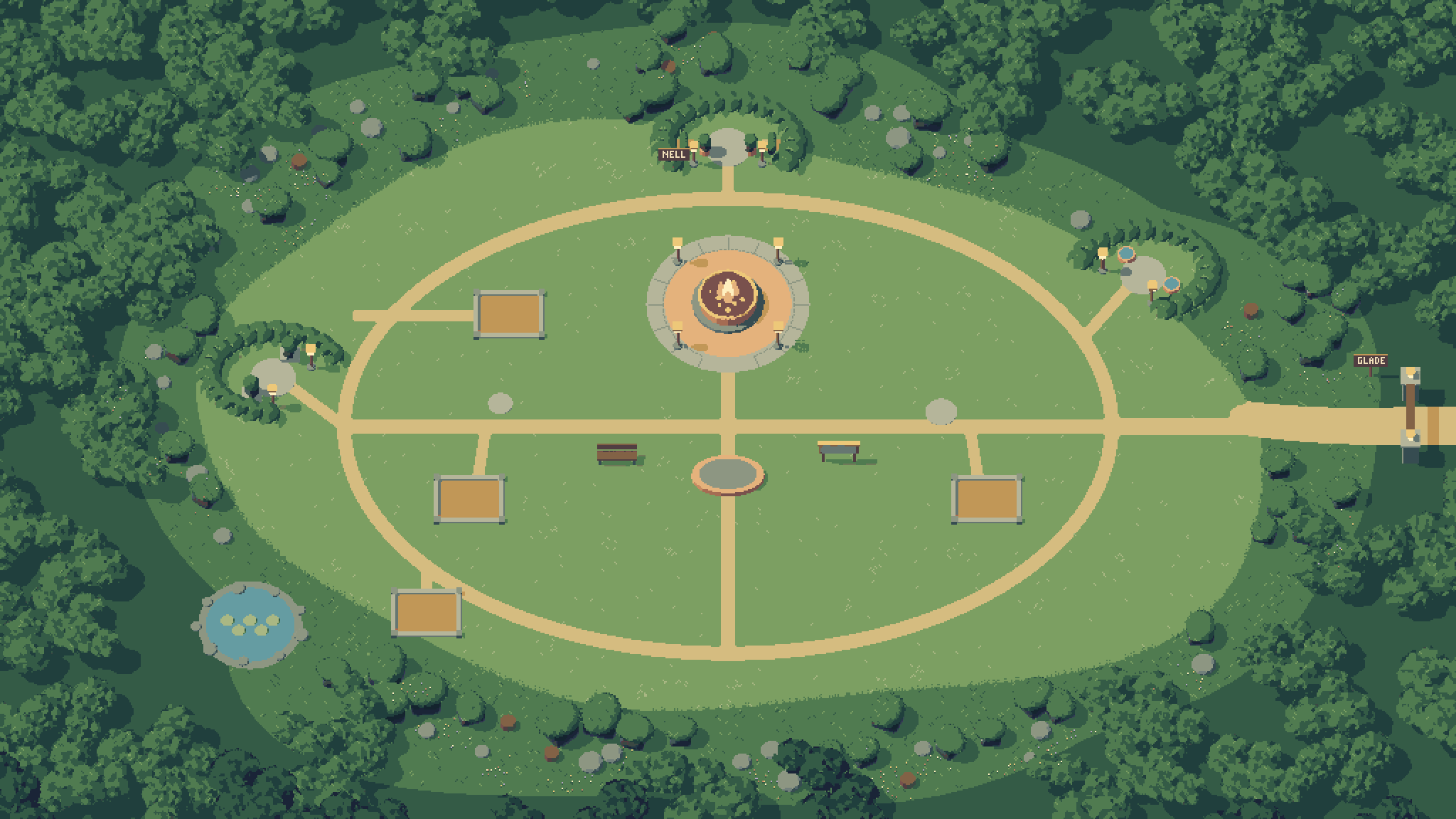
- Nearfield Glade G13 (30 October); trail state G14.
- Memory Meadow L12 (30 October), after L04 was rejected as "creepy" and too ordered.
- Mote Pocket M09 (30 October).
- Quiet District D09 (30 October).
- Starwell S11 (30 October), then S13 without a glass dome (31 October).
- Threadway: the live P24 3D scene (see Threadway 3D scene).
Development#
- In the alpha: the integration replaced H14 and S11 with H15 and S13 (
69c7b5470). The Glade, Meadow, Mote Pocket and Quiet District still use their older placeholder assets. - The lead's art audit (1 November) asks for maps to be split into ground, sortable objects and true overhangs, so cells can walk behind trees and rails. Memory Meadow L12's foreground layer is empty.
- State art (Starwell works, Glade states, Meadow refuge, Quiet repairs) exists and waits for the story facts that switch it on.
- The Threadway source contains third-party models. Its raw
.blendfiles stay private, and the release licence question is open (lead integration item 9).
Gallery#
See also#
Sources#
5ed726064:art/environment/README.md95339ee9d:art/environment/blender-study/README.md5ed726064:art/environment/blender-study/threadway-street/QUEUE.md1ded4c01c:docs/art-audit/2026-11-01/AUDIT.mdb89f778c2:src/main-game/game/art/SOURCES.json- docs/ops/agent-messages/2026-11-02-lead-full-project-reconciliation-audit.md (working copy, not in Git)
What links here (35)
- Art direction
- Astro VFX
- Build VFX
- Care VFX
- Character sprites
- Encounter backgrounds
- Flow
- Hearth podium
- Home art
- Home VFX
- Icon labels
- Inventory HUD
- Mote Pocket
- Movement VFX
- Neural Highway
- Orders VFX
- Palettes
- Panels VFX
- Places dialog
- Pressure front VFX
- Pull and Glide VFX
- Quest scroll
- Quests VFX
- Run HUD
- Studios interior
- Survey VFX
- Tendrils
- Threadway
- Threadway 3D scene
- Threadway residences
- Typography
- Vessel VFX
- VFX
- Ward VFX
- Workstreams